God is our
refuge and strength, a very present help in trouble. Psalm 46:1 (ESV)
“’teaching
them to observe all that I have commanded you. And behold, I am with you
always, to the end of the age.’” Matthew 28:20 (ESV)
God is our
example of being present with someone, because He is present with us
Jesus came
to this earth to experience life with people. He is now present with us when we invite Him
into our lives.
.
Luke 9:10-11
is one example of Jesus and his presence with others.“On their return the apostles told him all
that they had done. And he took them and withdrew apart to a town called
Bethsaida. When the crowds learned it,
they followed him, and he welcomed them and spoke to them of the kingdom of God
and cured those who had need of healing.” (ESV) Jesus
welcomed others, brought healing to their lives, and made time for others.He listened, dealt with their real heart
issues, and He asked questions that revealed the real issues they were dealing
with in their lives.He was not in a
hurry, even though He knew his time was short.
Bellevue
Christian Counseling explains that being present with another person involves:
Slowing down
to really be in a situation. Our age is one of extreme busyness—we are maxed
out, exhausted, and constantly multi-tasking.
Paying
attention. This means noticing details and nuances, and asking careful
questions for clarification.
Focusing on
the interaction. This is a deliberate, careful listening and involvement.
Patience.
When listening to another, check whether you are creating your response while
the other person is speaking. Are you waiting for them to finish speaking so
that you can get your thoughts out?
Empathy. A
dictionary definition of empathy is a “vicarious identification with or
experiencing of the actions, feelings, or attitudes of another.” Sympathy is
extending compassion to another in difficulty, while empathy knows what it is
like to be in the other’s shoes. (Bellevue Christian Counseling, 2019)
Deb Hinkel, Director for Spiritual Formation and Family Ministry at Hershey Free Church gives some important thoughts on being present in this video.
“A great way
to develop these characteristics in our lives is by noting how they are exemplified
in the character of Jesus. His empathy for us humans was clear—the apostle Paul
says in Galatians 2 that Christ 'emptied himself” and became a man. He walked
in our shoes and knows everything we feel, having been one of us. He slowed
down, stopped, and listened carefully to people with intention and deliberation
– witness his interaction with the Samaritan woman (John 4:7-42).
"While we can
develop skills that help us to be present, we should note that one of the names
of Jesus is Emmanuel, which means God-with-us. Jesus did not just model being
truly present, he also promised to be with us always – to be present with us.
Jesus, Emmanuel, is the most present person who ever lived. As we emulate
Christ in our treatment of others both inside and outside the counseling
setting, the cues we take come from his character. A Christian counselor is
called to ‘be with’ the client as Christ is with us. We sit with clients in
their crisis points, being present and accompanying them through desperate
times and places.
"At the same
time Christ is literally present with us, as he was in the first century. The
only difference is that we cannot see him, but we do sense him and talk with
him.
"If
God-With-Us, Emmanuel, shows up, fully present in our everyday life, then we
too can and should show up and be fully present to others as well.”
(Bellevue Christian Counseling, 2019) Are you fully present when talking to others? Are you fully present when you attend church? Do you listen to others and ask questions to draw them out? Do you share the hope found in Christ when the opportunity arises? Do you talk more than you listen? Can you empathize with others?
Bellevue Christian Counseling. (2019). Retrieved from
https://bellevuechristiancounseling.com/articles/being-present-how-does-this-relate-to-christian-counseling
“While
walking by the Sea of Galilee, he saw two brothers, Simon (who is called Peter)
and Andrew his brother, casting a net into the sea, for they were fishermen. And he said to them, ‘Follow me, and I will
make you fishers of men.’” Matthew
4:18-19 ESV
Fishermen
have to know what they are doing and apply that knowledge if they wish to
succeed. If we want to be fishers of
men, the basic knowledge we need is to know God.
John 17:3
says, “And this is eternal life, that they know you, the only true God, and
Jesus Christ whom you have sent.” (ESV) Might know
(γινώσκωσι). Might recognize or perceive. Eternal life consists in a continuing,
progressive perception of God in Christ. (Vincent, 1887)
Eternal life
is not just prolonged life. It is a quality of life that comes from being in
relationship with the Father and Son. John
usually uses Christ as a title. It is
used with Jesus’ name only here and in 1:17. The statement in 17:3 helps us understand
1:18, that Jesus fully revealed what God is like, with Jesus’ statement in
10:10 that he has come that people might have life, and have it abundantly.
These two purposes are really one, according to 17:3, because (abundant)
eternal life is defined as knowing (being in relationship with) the Father and
the Son. The only way to gain eternal life is to know the Father through the
Son (cf. 14:6). This knowledge is not intellectual, but relational. It involves
being in relationship. (Press, 2006)
“What is the
most important thing in the world to every Christian? It is to grow in the knowledge of God. The knowledge of God is the heart of
salvation and all true spiritual experience.
Knowing Him is what we were created for.” (Ferguson,
1986)
It is not
enough to know about God. We need to
know Him personally. We know God through
His Word and the revelation of the Holy Spirit.
Knowing Him involves spending time with Him, conversing with Him, and
thinking about Him. The more we know
Him, the more He changes the way we think and live. It is an ongoing process that is vital to our
life.
Colossians
1:10-11 exemplifies this change. “So as
to walk in a manner worthy of the Lord, fully pleasing to him: bearing fruit in
every good work and increasing in the knowledge of God; being strengthened with
all power, according to his glorious might, for all endurance and patience with
joy;” (ESV)
“God says, ‘Get
me out of the box.Know me as I am- the One
who was and is and is to come. [Rev. 1:8].Eternal.Holy.Awesome.Sovereign.Lord of all.’ God invites us to be gripped by His greatness.Shaken to the core of our being at the
realization of what He freely offers.” (MacDonald, 2005)
“There is no
such thing as genuine knowledge of God that does not show itself in obedience
to His Word and will. The person who
wants to know God but who has no heart to obey God will never enter the sacred
courts where God reveals Himself to the soul of man. God does not give divine knowledge to those
who have no desire to glorify Him.” (Ferguson, 1986)
In Jeremiah
9:23-24, God explains what our goal should be.
“Thus says the Lord: ‘Let not the wise man boast in his wisdom, let not
the mighty man boast in his might, let not the rich man boast in his riches,
but let him who boasts boast in this, that he understands and knows me, that I
am the Lord who practices steadfast love, justice, and righteousness in the
earth. For in these things I delight, declares the Lord.’”
“The
knowledge of God is a personal knowledge of a personal God. It is received by those alone who seek to
know Him in a spirit of dependence upon Him, and who ask for His Spirit to lead
them into the truth.” (Ferguson, 1986)
Philippians
3:8-10 says, “Indeed, I count everything as loss because of the surpassing
worth of knowing Christ Jesus my Lord. For his sake I have suffered the loss of
all things and count them as rubbish, in order that I may gain Christ and be
found in him, not having a righteousness of my own that comes from the law, but
that which comes through faith in Christ, the righteousness from God that
depends on faith— that I may know him and the power of his resurrection, and
may share his sufferings, becoming like him in his death.” (ESV)
“Genuine
encounters with God must be measured against and can never stray from the anchor
of God’s Word.” (MacDonald, 2005) God wants us to continue to grow in our
understanding of who He is and to experience Him relationally. He is the great and awesome God, but also our
loving Father. His revelation of His
character and will must conform to the revelation of God in the
Scriptures. He never changes, and He has
given us His Word to help us know Him.
Is knowing
God a major focus of your life? What can
you do to not only learn about Him, but to know Him better personally? Spend time focused on Him. So, in conclusion,
as 2 Peter 3:18 states, “But grow in the grace and knowledge of our Lord and
Savior Jesus Christ. To him be the glory both now and to the day of eternity.
Amen.”
For those interested in knowing more about fishing in N.T. times, read on.
There are
different kinds of nets in the Gospels. The dragnet (sagēnē, σαγήνη) is a
football field in length and 10’ wide with floats on top and sinkers on the
bottom. It is spread out parallel about a hundred yards off shore. The net is
dragged ashore by ropes on either end surrounding and capturing the fish as it
is pulled ashore. (Laney, 2016)
The cast-net
(diktyon, δίκτυον) is a circular net with weights around the outer edge to make
it sink. This net is arranged on the arm and then cast into the water with the
opposite arm. The net spreads out and the weights pull it to the bottom
trapping the fish. Fish can be retrieved
one-by-one or by wading around the net gathering the sinkers and pulling the
net with the fish to shore or into the boat. The cast-net is mentioned in Mark
1:16–18 where Jesus said, “Follow me and I will make you become fishers of
men.” (Laney, 2016)
The trammel
net consists of three layers of connected nets - two exterior walls of large
mesh and a middle layer of smaller mesh.
The plural “nets” (diktya) rather than the singular “net” (diktyon)
distinguishes them in the Gospels. Trammel nets are about 100’ long and
attached in a series. It was used
during the night when the fish could not see the net. Weights pull the net down into the water while
floats keep the top side of the wall near the surface. Fishermen wade in the water making noise and
splashing with oars. The fish attempt to swim away but are trapped in the small
mesh. The trammel net is probably the type in Mark 1:19–20 and Matt 4:21–22
where James and John were mending their nets. The trammel net also appears to
be the one in the great catch of fish (Luke 5:1–7) and John’s account of the
miraculous catch (John 21:3–11). (Laney, 2016)
Works Cited
Ferguson, S. B. (1986). A Heart for God.
Colorado Springs: NavPress.
Laney, J. (2016). Fishing the Sea of Galilee. In B.
(Eds.), B. Beitzel, & K. Lyle, Lexham Geographic Commentary on the
Gospels. Bellingham, WA: Lexham Press.
MacDonald, J. (2005). Gripped By the Greatness of
God. Chicago: Moody Publishers.
Press, B. S. (2006). he NET Bible First Edition
Notes (Jn 17:3). Biblical Studies Press.
Vincent, M. R. (1887). Word Studies in the New
Testament (Vol. 2, p.263). New York: Charles Scribner's Sons.
“While
walking by the Sea of Galilee, he saw two brothers, Simon (who is called Peter)
and Andrew his brother, casting a net into the sea, for they were fishermen.
And he said to them, ‘Follow me, and I will make you fishers of men.’Immediately they left their nets and followed
him.”Matthew 4:18-20 ESV
Jesus asked
the disciples to become followers, but a different type of follower from ones
that followed other Rabbis.They were
not just asked to follow to absorb teaching, but to actively participate in the
ministry of fishing for men.This
required a total change from their normal way of life. (France, 1985) In the
same way, along with learning from God, we are also asked to participate with
Him in what He is doing in the world.He
uses our lives to bring change to the world.
They heard
Jesus and obeyed.Often when the Bible
tells us to hear something, it means to listen and obey.Obedience is a response. God has already
acted on our behalf, and our response should be to follow his will. In both OT
and NT, hearing (שָׁמַע, šāmaʿ, “to hear”; ὑπακούω, hypakouō,”to obey”) often
is a call to God’s people to follow him (or his law).In the NT, Jesus obeys the Father, even to
die on a cross (Phil 2:8). Following Jesus’ precedent (Mark 12:28–34), love is
the motivation for obedience (e.g., Rom 13:8–10; Jas 2:8). (Gabrielson, 2014) Nicole Given, Worship Pastor at Deep Rivers Church, shares her experiences with following God in this video.
We do not
serve God out of fear, but out of love.1 John 4:18 tells us, “There is no fear in love, but perfect love casts
out fear. For fear has to do with punishment, and whoever fears has not been
perfected in love.” (ESV)
“Our wants
and longings and desires are at the core of our identity, the wellspring from
which our actions and behavior flow.Our
wants reverberate from our heart, the epicenter of the human person.Thus Scripture counsels, ‘Above all else,
guard your heart, for everything you do flows from it’ (Prov. 4:23).Discipleship, we might say, is a way to
curate (pull together, sift through)
your heart, to be attentive to and intentional about what you love.”(Smith, 2016)
Phil. 1:9-11
says, “And it is my prayer that your love may abound more and more, with
knowledge and all discernment, so that you may approve what is excellent, and
so be pure and blameless for the day of Christ, filled with the fruit of
righteousness that comes through Jesus Christ, to the glory and praise of God.”
(ESV)
We seek to
know what we love.Love is a subconscious
desire that works without our even thinking about it. (Smith, 2016)The
question is what do you love?What is
your deepest desire?It is easy to allow
culture to corrupt and replace what we love so that our actions and habits push
us in a direction away from following God.Recognition, financial security, possessions, acceptance, and power are
all examples of things we can desire that push against trusting and loving God.We need to constantly check to see what is
motivating us, because it is very easy for the world to slip the wrong things
into our hearts. That is where
repentance comes in. Is there anything that you long for that has snuck into
your heart and changed your behavior?
Col. 3:12-14
tells us, “Put on then,
as God's chosen ones, holy and beloved, compassionate hearts, kindness,
humility, meekness, and patience, bearing with one another and, if one has a complaint
against another, forgiving each other; as the Lord has forgiven you, so you
also must forgive. And above all these
put on love, which binds everything together in perfect harmony.” (ESV)
Compassion,
kindness, and humility are examples of virtues. Love holds all the virtues together.Virtues are the good moral habits that are
woven into who you are and how you are inclined to act. (Smith, 2016)“to become virtuous is to internalize the law
…so that you follow it more or less automatically.” (Smith, 2016)People will see the change as we choose to
keep our eyes on Christ and follow His ways.
We learn
through God’s revelation in His Word, through His Spirit, and through imitation
(1 Cor. 11:1), and we change as we incorporate new habits into our lives as we
are compelled by love.
Works
Cited
France, R. (1985). Matthew: an introduction and
commentary (Vol. 1, p.109). Downers Grove, IL: InterVarsity Press.
Gabrielson, T. (2014). Lexham Theological
Workbook. Bellingham, WA: Lexham Press.
Smith, J. K. (2016). You Are What You Love - The
Spiritual Power of Habit. Grand Rapids: Brazos Press.
“While
walking by the Sea of Galilee, he saw two brothers, Simon (who is called Peter)
and Andrew his brother, casting a net into the sea, for they were fishermen. 19
And he said to them, ‘Follow me, and I will make you fishers of men.’ 20
Immediately they left their nets and followed him.”Matthew 4:18-20 ESV
They heard
the call and responded.The question is
do we hear God’s voice?Oswald Chambers
writes:
Because I have listened definitely to one thing from God, it
does not follow that I will listen to everything He says. …If I love my friend,
I intuitively detect what he wants, and Jesus says, “Ye are My friends.” Have I
disobeyed some command of my Lord’s this week? If I had realized that it was a
command of Jesus, I would not consciously have disobeyed it; but most of us
show such disrespect to God that we do not even hear what He says, He might
never have spoken.
The destiny of my spiritual life is such identification with
Jesus Christ that I always hear God, and I know that God always hears me (John
11:41). If I am united with Jesus Christ, I hear God by the devotion of hearing
all the time. A lily, or a tree, or a servant of God, may convey God’s message
to me. What hinders me from hearing is that I am taken up with other things. It
is not that I will not hear God, but that I am not devoted in the right place.
I am devoted to things, to service, to convictions, and God may say what He
likes but I do not hear Him. The child attitude is always “Speak, Lord, for Thy
servant heareth.” If I have not cultivated this devotion of hearing, I can only
hear God’s voice at certain times; at other times I am taken up with
things—things which I say I must do, and I become deaf to Him, I am not living
the life of a child. Have I heard God’s voice to-day?(Chambers, 1986)
Do we allow
ourselves to be so busy doing good things that we do not take the time or
concentration to hear what God is saying to us?We all have so many demands in life.They can become a distraction that fills our minds as well as our time.We need to be intentional about hearing God.
How do we
hear God’s voice? We hear through His Spirit which indwells us as believers.
1
Corinthians 2:10-12 says, “these things God has revealed to us through the
Spirit. For the Spirit searches everything, even the depths of God. For who knows a person's thoughts except the
spirit of that person, which is in him? So also no one comprehends the thoughts
of God except the Spirit of God. Now we
have received not the spirit of the world, but the Spirit who is from God, that
we might understand the things freely given us by God.” (ESV) This can
happen in different ways.It may be God
speaking to us as we read His Word, and it pierces our heart.He may give us a picture, word, or
dream.He may speak to us through a
sermon, worship music, creation, or something He reveals to another Christian
for us.It may be a conviction He places
on our heart or peace or lack of peace in a decision we make.He gives us burdens to pray for others.
John
16:13-14 promises, “When the Spirit of truth comes, he will guide you into all
the truth, for he will not speak on his own authority, but whatever he hears he
will speak, and he will declare to you the things that are to come. 14 He will
glorify me, for he will take what is mine and declare it to you.”God wants to communicate with us.It may be in a different way from what we
were expecting. Check out this video clip Ryan Denlinger allowed me to tape for an example of how God spoke in an unexpected way-
We need to
be able to recognize His voice.This
gets better with practice.He will never
tell us to do something contrary to what He has revealed in His Word. We need to respond to what He is teaching us
and where He is correcting us so we will be able to hear Him better.
John 14:26
explains, “But the Helper, the Holy Spirit, whom the Father will send in my
name, he will teach you all things and bring to your remembrance all that I
have said to you.”
If we are
not reading God’s Word, we are missing an essential piece.The Bible is His letter to us, and we find He
illuminates the passages in new ways each time we read it, speaking what we
personally need to hear.We need to open
our minds and hearts to listen when we read.Reading the Bible is not an obligation, but an opportunity for
fellowship.
1 John 2:27
says, “But the anointing that you received from him abides in you, and you have
no need that anyone should teach you. But as his anointing teaches you about everything,
and is true, and is no lie—just as it has taught you, abide in him.”Let your devotional time be a two-way
conversation.Learn to be silent before
God and allow Him a chance to speak.
I have been
impressed with the way people have responded in the Morehead City area after
Hurricane Florence.There has been such
an attitude of gratitude and concern for others.I heard over and over, “Others had it so much
worse than me.” And “There are others who need help more than I do.”I talked to an insurance agent who commented
on the lack of the entitlement viewpoint.People displayed gratitude and not greed.
In the Island Review, Realtor Julia Batten Wax
commented, “In all those post hurricane Florence conversations we have had with
friends, family, even casual strangers waiting in line at the grocery store,
the sentences almost always begin, ‘I’m so thankful, I’m so grateful.’”
In the same
publication, Atlantic Mayor Trace Cooper aptly notes, “While we don’t control
the weather, we do control how we respond to storms.It is the response that matters most.We are not defined by what happens to
us.Rather, it is how we respond that
determines who we are.”
Sharing Italian Ices
He adds
specifics.“When our citizens returned
to check on their property, they checked on their neighbors as well.Then, they turned their attention to the
larger community.Our police and fire
departments received so many donations of food and water for our team and our
citizens that we, literally, had to call in the National Guard to transport the
excess supplies to other communities in Carteret County.”
These
examples make me think of two verses.I
Corinthians 12:26 teaches, “If one member suffers, all suffer together; if one
member is honored, all rejoice together.”I Thessalonians 5:18 exhorts us, “Give thanks in all circumstances; for
this is the will of God in Christ Jesus for you.”
Life brings
both good and bad experiences.As Mayor
Cooper commented, we cannot control what happens to use, but we can control our
response.God wants us to be able to
thank Him and praise Him even we face negative, hard things in our lives.We don’t have to be thankful for the storm,
but we can be thankful for God’s care in the storm and the good He brings in
the aftermath of the storm.
God draws
people to Himself, helps people re-evaluate how they are living their lives,
brings families and communities into a closer relationship, exposes past hurts
that have not been dealt with, and allows us to minister His love to
others.I think it is amazing to find
people who see beyond their own hurts to the hurts of others.That is exactly what God calls us to do, even
when we are not hit by a hurricane.
One Harbor Volunteers Join ReachGlobal Crisis Response to Help
“So we,
though many, are one body in Christ, and individually members one of
another.Having gifts that differ
according to the grace given to us, let us use them,” Romans 12:5-6a After
Hurricane Florence hit NC, Pastor Donnie drove through the community with multiple
stops to help people.He seems to know
everyone!People knew to contact him for
help, and he would also check to see if others were okay.A call came to help a woman with children who
had no food.He made arrangements for
his wife to take them food.There were
multiple calls about holes in roofs.We
stopped, gathered information, prayed with people, put them on a list to be
helped, and he was out the next day to help put on roof tarps.Donnie was sensitive to emotional needs as
well as physical ones.It was evident
that he was wired to be a first responder. He was wise
enough, however, to know that this was only his role for the first couple of
weeks.Confident in the abilities of his
staff, he was able to step back and let others take the lead so he could
continue with the job God had called him to do on a weekly basis.The church joined with ReachGlobal Crisis
Response to rebuild homes and lives in the community.
It was
impressive to see how well the church as a whole responded.Volunteers poured in to pray, prayer walk,
provide meals for teams, write notes of encouragement to homeowners, go out on
trauma care teams, help with home gutting, provide airport transportation,
provide temporary staff housing, lead devotions, help with office work, and
host teams at the church.Everyone found
a way to use their gifts to help the effort to restore lives in their
community.
It will be
exciting to see how God continues to use His church to reach this community
with the love of Christ.It is good to
see the body of Christ working together as the hands and feet of Jesus.
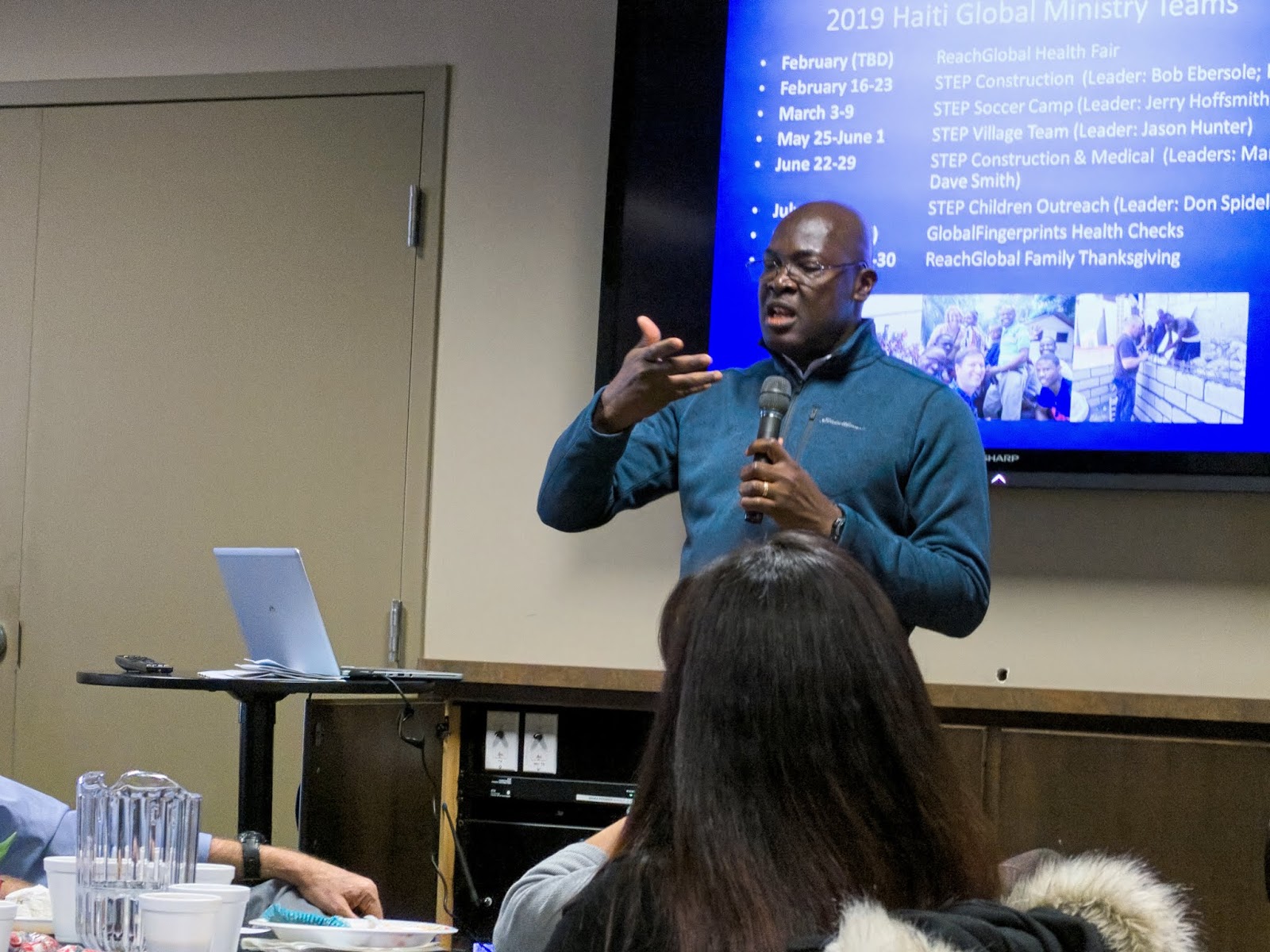
Looking at
life in Haiti, it is easy to be discouraged.I see many positive things, but there are life challenges too.There are also many things that seem to be
beyond change, but that is not true.Nothing is stronger than God’s power.Wawa said, “God keeps telling us, ‘I know what I’m doing,’ This is what
keeps us encouraged.I believe Haiti can
change, because God is in it.”
That does
not mean Wawa is sitting back and just waiting.He is seeking what God would have him to do and partnering with
God.Wawa explained, “We are proud to be
training students to lead, to change philosophy, to change churches, and to
impact the community where they are located.We have developed a team at STEP of professors and staff to influence
students.”
Discipleship
has indeed become the trademark of STEP seminary.They do not want to simply transfer
knowledge.“It is not enough to know
about God.We need to actually know God,”
explained Wawa. The professors are doing life together with students to develop
disciples which involves meals and trips together so they can see how
Christianity relates to life.Students
are then doing the same with others.STEP is meeting life needs in the community through building projects,
health care, and planting house churches.More than 100 people have come to accept Christ as their savior through
these house churches.
Please pray
for teachers, students, and graduates as they seek to transform the Haitian
worldview.